
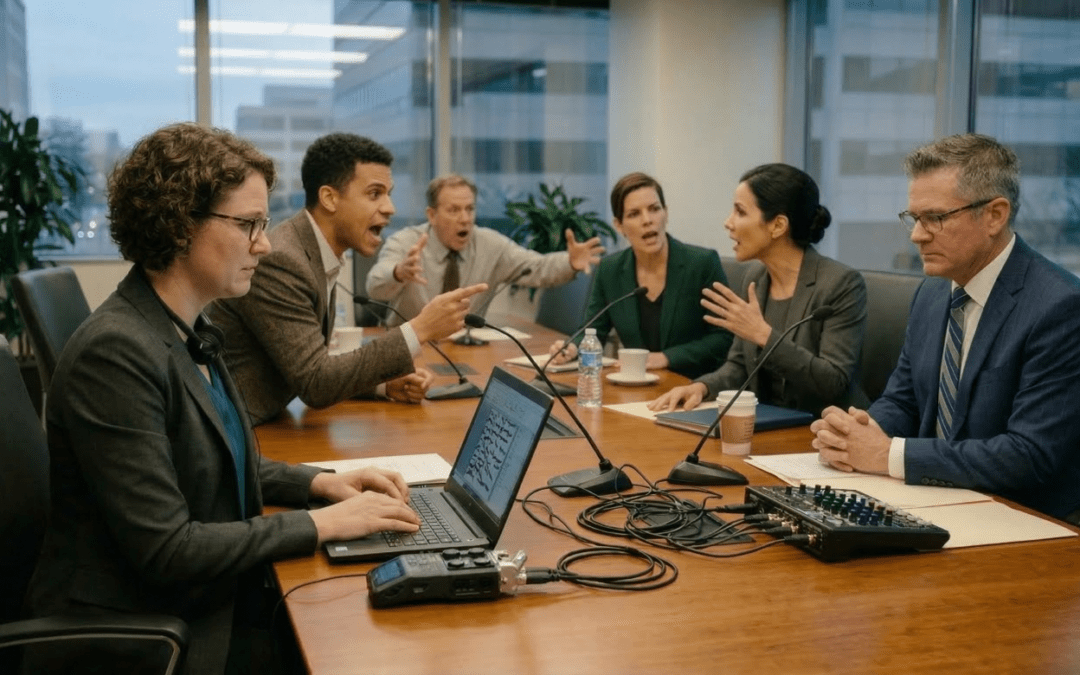
For decades, the court reporter has traditionally controlled the record — helping manage the room so the transcript is clear and accurate. That often includes:
- Asking speakers to slow down
- Stopping attorneys and witnesses from talking over each other
- Ensuring answers are audible
- Catching statements that microphones may miss with a trained human ear
As digital court reporting becomes more common, the dynamics in the room may start to evolve.
In some digital reporting environments, the person monitoring the proceedings may not intervene as actively to control the room. If that becomes the case, attorneys may need to take a more active role in managing the pace and clarity of the conversation to ensure the transcript is reliable.
Which raises an interesting question for litigators:
If no one is actively controlling the room, could a deposition become difficult to transcribe accurately — even turning into a nightmare transcript?
Cross-talk, people speaking quickly, voices dropping off microphone, and overlapping objections can create challenges for any record.
Another point many attorneys may not realize: most court reporting agencies will not release the audio recording of a deposition without a subpoena. In many cases, the official record is still the transcript, not the audio backup.
That makes the clarity of the spoken record during the deposition even more important.
FAQs
What is digital court reporting?
Digital court reporting typically uses microphones and recording technology to capture the deposition audio while a technician monitors the proceeding. The audio is later used to produce a transcript, often with the assistance of transcription software and editors.
How is digital court reporting different from stenographic reporting?
Traditional stenographic reporters use specialized machines and training to capture spoken words in real time. They often manage the pace of the deposition by asking speakers to slow down or avoid talking over each other. Digital reporting relies primarily on recorded audio, which may require attorneys to be more mindful of speaking clearly and avoiding cross-talk.
Can digital court reporting affect transcript accuracy?
Transcript accuracy can depend heavily on how clearly the deposition conversation is conducted. Cross-talk, overlapping speech, or speakers moving away from microphones can make any record more difficult to transcribe. Clear speaking and structured questioning help improve the reliability of the final transcript.
Who controls the deposition record during a deposition?
In traditional stenographic reporting, the court reporter often helps manage the room to maintain a clear record. In some digital reporting environments, that responsibility may fall more heavily on the attorneys conducting the deposition.
Can attorneys request the audio recording of a deposition?
In many cases, the official legal record of a deposition is the transcript rather than the audio recording. Many reporting agencies require a subpoena or court order before releasing the original audio recording.
What can attorneys do to ensure a clear deposition transcript?
Attorneys can help maintain a reliable record by:
- Avoiding cross-talk
- Asking speakers to answer verbally rather than with gestures
- Speaking clearly and at a steady pace
- Waiting for objections to finish before continuing questions
These practices help ensure the transcript accurately reflects the testimony given during the deposition.
No Results Found
The page you requested could not be found. Try refining your search, or use the navigation above to locate the post.